Bone grafting for dental implants: is it necessary?
 Dr Pushkar Sobti
All-on-X implantologist, Rajouri Garden, Delhi
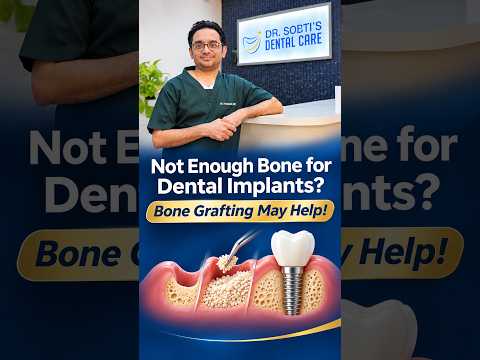
"Do I need a bone graft?" is one of the first questions patients ask me, usually because someone has told them their bone is too thin for an implant. In fact, most people do not need one. Some do, and for them a graft is what makes a long-lasting implant possible. In the video I explain how we decide, and below are the details.
What a bone graft does
An implant is a titanium root that sits inside the jawbone. To stay strong for years it needs bone all around it, with enough height and enough width. A bone graft adds bone where there isn't enough. The graft material acts as a framework, and over the following months your own bone grows into it and takes its place.
Why bone goes missing
- A tooth was lost some time ago. Without a root to support, the jawbone at that spot slowly shrinks. Most of this happens in the first few months after the tooth is removed. (More in what happens to your jaw when a tooth is lost.)
- Gum disease has eaten away the bone around a tooth before it was removed.
- A difficult extraction or an old infection damaged the bone wall.
- In the upper back jaw, the sinus drops down after the back teeth are lost and leaves only a thin floor of bone. Building it up from inside is called a sinus lift.
- Years of wearing a loose denture press on the gum and wear the bone down.
How we decide: the CBCT scan
A flat X-ray cannot show bone width, so it cannot answer this question properly. Every implant patient at our clinic gets a CBCT scan first. It shows the height and width of the bone in 3D, along with the nerve in the lower jaw and the sinus in the upper jaw. I plan the implant on the scan and can see straight away whether it will sit fully in bone or whether part of it would be exposed. That decides whether a graft is needed, and how big.
Graft with the implant, or graft first?
Same sitting. When the implant can be fixed firmly in the bone that is there, a small graft is packed around it at the same visit. This is the most common situation, and it adds no extra surgery.
Graft first, implant later. When too much bone is missing to hold the implant steady, the graft is placed on its own and left to heal for a few months. The implant goes in once the new bone is ready.
At the time of extraction. If a tooth has to be removed, grafting the socket straight away helps keep the bone from shrinking, so the implant later is simpler. When the bone is healthy, the implant itself can sometimes go in that same day (see the immediate implants video).
When a graft can be avoided
For one or two missing teeth, careful planning on the scan sometimes lets us choose an implant size and angle that fits the existing bone. For patients missing all their teeth, All-on-4 and All-on-6 tilt the back implants into the stronger bone at the front of the sinus, which is why many full-arch patients never need a graft. Where bone loss is severe, basal implants, or zygomatic and pterygoid implants anchored in the cheekbone and the back of the upper jaw, can give fixed teeth without grafting. Each of these has its own trade-offs, and I explain them at the consultation.
What recovery is like
Grafting is done under local anaesthesia, usually in the same appointment as the implant. Expect some swelling and soreness for a few days, controlled with the medicines we prescribe. Soft food on that side, no smoking, and the cleaning routine we give you all help the graft take. We review you after the procedure and check the bone on the scan before the final teeth are made.
Cost
A graft is added only if your scan shows you need it, and it appears in your written estimate before treatment starts. For how implant prices are worked out, see dental implant cost in Delhi, or send us your scan for a free assessment.
Questions patients ask
Do I always need a bone graft before a dental implant?
No. Most patients do not. A graft is needed only when the CBCT scan shows there is not enough bone, in height or width, where the implant must go. If you need one, it is written into your treatment plan before anything starts.
How do you know if I need a bone graft?
From the CBCT scan. A normal X-ray is flat and cannot show the width of the bone. The 3D scan shows the height and width of the jawbone, the nerve and the sinus, so the decision is made from measurements, not guesswork.
Can the graft be done at the same time as the implant?
Often, yes. When the implant can be held firmly in the bone that is already there, a small graft is placed around it in the same sitting. When the bone loss is larger, the graft is done first and the implant is placed after it has healed.
How long does a bone graft take to heal?
It depends on the size of the graft. A small graft placed with the implant heals along with the implant. A larger graft done on its own usually needs a few months before the implant goes in. Your plan will give you the timeline for your case.
Is bone grafting painful?
It is done under local anaesthesia, so you should not feel pain during the procedure. Afterwards most patients have some swelling and soreness for a few days, which is managed with the medicines we prescribe.
Can I get implants without a bone graft if I have bone loss?
Sometimes. In full-arch cases, All-on-4 and All-on-6 tilt the back implants into stronger bone, and zygomatic, pterygoid or basal implants can avoid grafting when bone loss is severe. Whether this suits you depends on your scan.
Does bone grafting add to the cost?
Yes, when it is needed. It is only added if your scan shows you need it, and it is included in the written estimate you get before treatment, so there are no surprises later. See the dental implant cost page for how prices are worked out.
More videos
 0:54
 0:31
 0:39
See all of Dr Pushkar's dental implant videos.
Not sure if you need a graft?
Send your X-ray or CBCT scan on WhatsApp +91 80767 77307 for a free assessment, or call the front desk on +91 87449 85976 to book a consultation with Dr Pushkar Sobti (by appointment) at Dr Sobti's Dental Care, J 12/26, First Floor, Rajouri Garden, New Delhi.