The CBCT scan: seeing your jaw in 3D
 Dr Pushkar Sobti
All-on-X implantologist, Delhi
Of all the equipment in the clinic, the CBCT scanner is the one implant planning depends on most. A good implant starts with knowing exactly what is inside the jaw, and nothing else shows that as clearly.
Patients often ask why they need "another X-ray" when they already have one from their dentist. This post is the answer.
What a normal X-ray misses
A standard dental X-ray, or the wide panoramic one that shows all your teeth in a curve, is a flat picture of a three-dimensional thing. It shows height reasonably well. It can't show width at all.
That matters, because a jaw that looks tall and healthy on a flat film can be thin from front to back, sometimes only a few millimetres where the implant needs eight or more. A flat image also squashes everything onto one plane, so the nerve in the lower jaw or the floor of the sinus in the upper jaw can look further away, or closer, than it really is. In implant work, a couple of millimetres either way decides whether a plan is safe.
How CBCT works
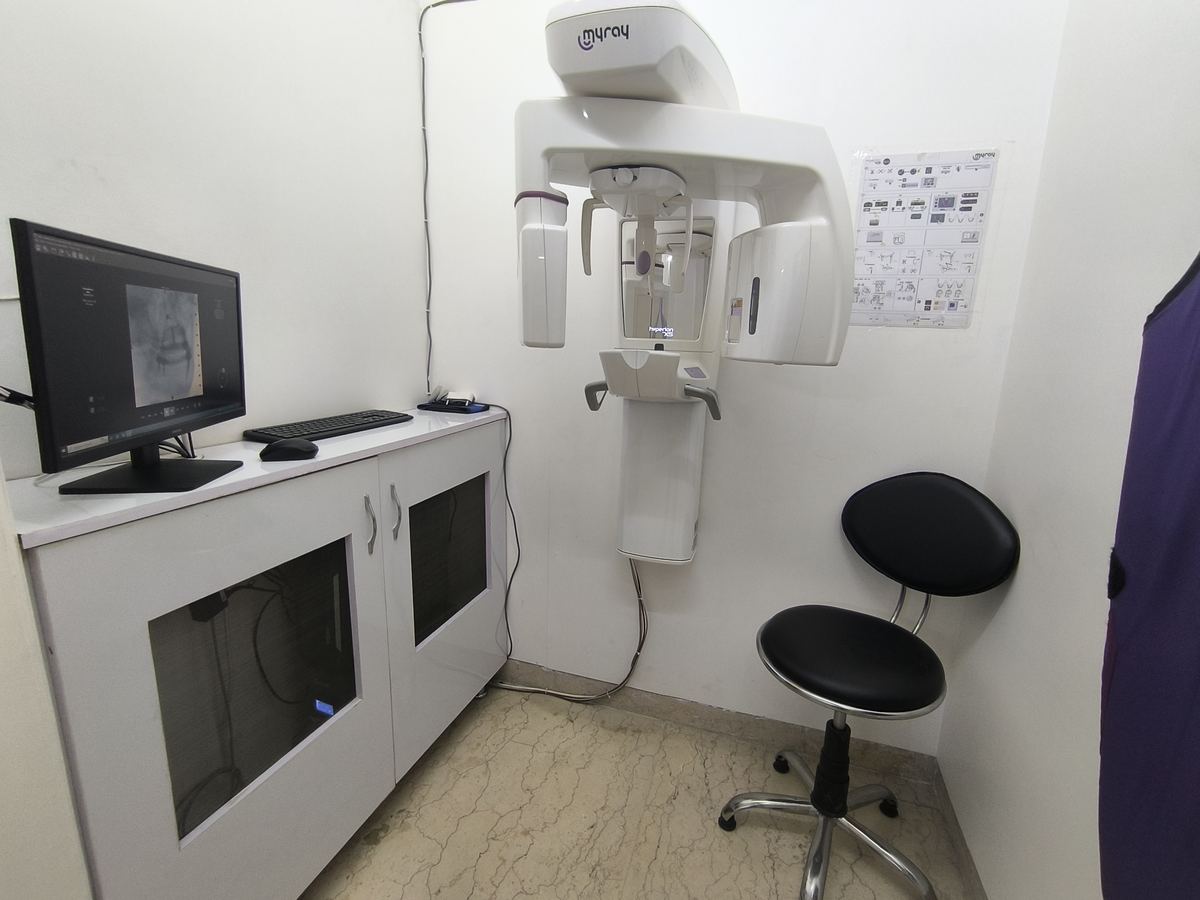
CBCT stands for cone beam computed tomography. You stand or sit still with your chin resting on a support while the machine turns once around your head. During that turn it takes hundreds of small images from different angles, using a cone-shaped beam. A computer then puts them together into a 3D model of your jaw.
The scan itself takes well under a minute. There's no tunnel to lie in and nothing to swallow. Ours is a MyRay Hyperion X5, and it is in the clinic, so the scan is done on the day of your consultation and is included in the implant price.
What I can see on it
Once the scan is loaded, I can slice through your jaw in any direction, at any point, and measure it to a fraction of a millimetre. For implant planning, the things I look at are:
- the height and width of the bone where each implant will go
- how dense the bone is, which affects how firmly an implant will hold on the day
- the path of the nerve that runs through the lower jaw and gives feeling to the lip and chin
- the position and health of the sinuses above the upper back teeth
- any infection, cyst or old root left behind that a flat film didn't show
For full-arch cases, the scan also shows me where the strongest bone is. That's what decides whether All-on-4 is possible, whether the back implants should be tilted, or whether zygomatic or pterygoid implants would avoid a bone graft altogether.
From scan to plan
The scan is not just for looking. It becomes the base of the whole digital plan. I combine it with a 3D scan of your teeth and gums from the intraoral scanner, design the final teeth on screen first, and then place each implant virtually in the bone underneath, at the angle and depth the teeth need. From that plan, a surgical guide is made that steers the drill on the day. I'll go through that process properly in the next two posts.
I go through the scan with you on the screen at the consultation. Seeing your own jaw turn in 3D, with the bone and nerve marked, explains more than I can in words.
What about radiation?
It's a fair question. A dental CBCT uses far less radiation than a medical CT scan of the head. A small scan focused on one area of the jaw gives a dose in the same range as the natural background radiation everyone receives over a few days to a few weeks just from living on earth. A larger scan of both jaws is somewhat more, but still well below a hospital CT.
The scan area is kept as small as the case allows. For pregnant patients, implant treatment and the scan are normally postponed.
If you already have a CBCT scan from another centre, send it to me on WhatsApp before you visit. If it's recent and covers the right area, we may not need to repeat it.
Questions
Is a CBCT scan safe?
Yes. A dental CBCT scan uses a low dose of radiation, much lower than a medical CT scan of the head. A small, focused scan is roughly equal to the natural background radiation you receive over a few days to a few weeks.
Do I need a CBCT scan for a dental implant?
For almost every implant, yes. A flat X-ray cannot show the width of the bone or the exact position of the nerve and sinus in three dimensions, and those are what decide where an implant can safely go.
Is the CBCT scan included in the implant price?
At Dr Sobti's Dental Care the CBCT scan is included in the implant price, and it is taken in the clinic on the day of your consultation.
Next · Sat 07 Nov
Goodbye to impression trays. How an intraoral scanner records your teeth in 3D, and why it's more comfortable.
Previous
Your first implant consultation
Videos: the CBCT scan explained
 0:31
 0:59
 0:57