Goodbye to impression trays
 Dr Pushkar Sobti
All-on-X implantologist, Delhi
Ask almost anyone what they dislike most about getting a crown or a denture, and many will say the impression. A metal or plastic tray filled with thick, cold paste is pushed over your teeth, and you sit with it in your mouth for a few minutes while it sets. For people with a strong gag reflex, it can be the worst part of the whole treatment.
We hardly use those trays any more. For most patients, the impression is now taken with a small camera.
What an intraoral scanner is
An intraoral scanner is a handheld wand, a little thicker than an electric toothbrush. I move it slowly over your teeth and gums, and it takes thousands of pictures per second. The software stitches those pictures together, and a 3D model of your mouth builds up on the screen in front of you as I go.
A full arch usually takes a few minutes. There is no paste and nothing to bite into. If you need a break, we just stop, and the scan carries on from where it left off when we start again. Patients who gag easily, who found trays unbearable before, usually get through a scan without much trouble.
We have three scanners in the clinic, a Medit i900, a Medit i500 and an Upcera.
Why it matters for implants
For an implant crown, the impression has to record exactly where the implant sits in the bone, at what angle and at what depth, and how the gum around it is shaped. To do that, a small scan body is screwed onto the implant for a minute. The scanner picks up its position, and the software knows precisely where the implant is underneath.
With a tray, there are several places small errors can creep in. The paste can tear or pull away, it shrinks slightly as it sets, and the model then has to be poured in plaster and sent to a lab. A digital scan skips most of those steps. I can check it on the screen immediately, zoom in on the edges, and rescan any area that isn't perfect before you leave the chair.
For a single implant or a small bridge, studies show digital impressions are as accurate as conventional ones. For full-arch cases, where a long span of teeth has to fit across several implants, the scan is combined with other checks to confirm the fit before the final teeth are made.
From scan to tooth
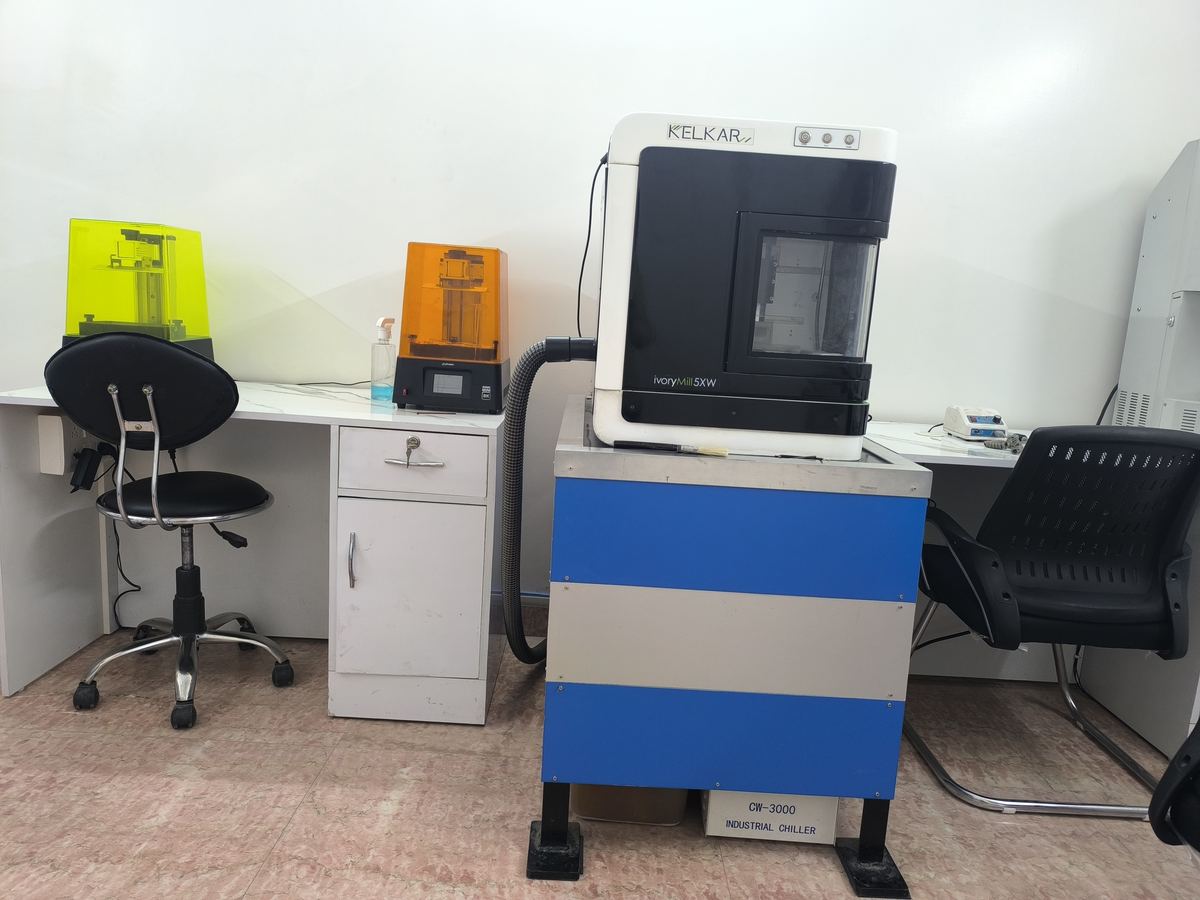
Once the scan is done, the file goes straight to our lab, which is inside the clinic. The new tooth is designed on screen in exocad, shaped to match your bite and the teeth next to it, and then milled from a solid block, zirconia on our Roland mill or glass ceramic on the Upcera.
Because nothing has to be posted to an outside lab, the time from scan to finished tooth is much shorter. If something needs adjusting at the try-in, it can be changed and milled again without starting from scratch. The scan file also stays on record. If a crown ever breaks years later, a new one can usually be made from the same data.
It's also part of the plan
The scan of your teeth and gums isn't only used at the end, for the crown. It is also used at the start. Combined with the CBCT scan of the bone from the last post, it lets me design the final teeth first and then plan each implant underneath them, which is the subject of the next post.
If you have put off treatment because impressions made you gag, this is worth knowing. Ask us about it when you call, or message on WhatsApp.
Digital impressions are included in our implant price. See the full dental implant cost in Delhi list.
Questions
What is an intraoral scanner?
A small handheld camera that takes thousands of pictures of your teeth and gums and stitches them into an accurate 3D model on a computer. It replaces the trays of impression paste used in the past.
Is a digital impression accurate enough for implants?
Yes. For single implants and small bridges, digital impressions are at least as accurate as conventional ones, and the scan can be checked on screen straight away. For full arches the scan is combined with other records to check the fit.
Is an intraoral scan uncomfortable?
Most people find it far easier than an impression tray. There is no paste, nothing to bite into for minutes, and you can pause whenever you need to. Patients with a strong gag reflex usually manage it without trouble.
Next · Mon 09 Nov
Planning your implant on screen. How the final teeth are designed first, and the implants placed virtually beneath them.